When is the BEST time to visit the hatchery?
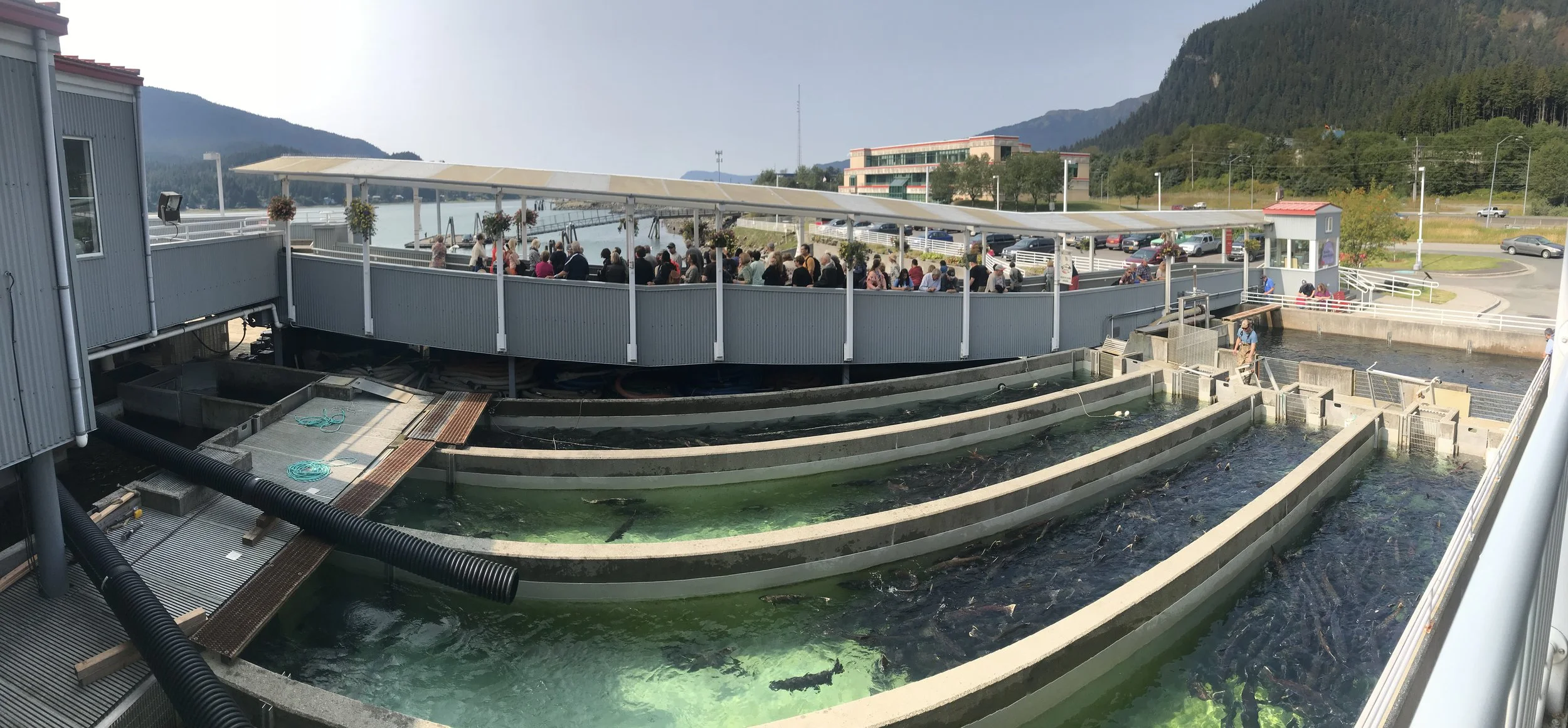
From early July through September, the salmon ladder is running and adult salmon are returning. This is a spectacle you do not want to miss! In our opinion July 4th through August 10th is the absolute best time of year to visit.
Will I be able to see Salmon?
From July through early October there will be adult salmon returning to the facility.
From April through June of the next few years, beginning in 2026, the visitor friendly rearing facility for juvenile salmon will be closed due to a planned penstock replacement of the water supply for the hatchery. We will have limited water availability during this period and will be unable to have salmon available for viewing in that area. The Macaulay Salmon Hatchery water supply is pass through water from the Salmon Creek Hydro project managed by Alaska Electric Light & Power Company (AEL&P). They are replacing an original section of the penstock which was installed in 1914! AEL&P has worked closely with DIPAC through every phase of this project. More details on the Salmon Creek Reservoir can be found HERE.
To accommodate this lack of salmon viewing experience in the early summer months, we have added a new smolt tank in the Visitor Center! This way you can see juvenile salmon before the adults begin to return.
How much time should I plan to spend at the Hatchery Visitor Center?
We recommend you plan on no less than 45 minutes to see the full visitor center, watch the educational videos & shop. When the salmon are returning, early July through September, you may want an additional 15 minutes to an hour if you enjoy watching fish behavior.
Can I fish at the hatchery?
There is a public sport fishing dock at Wayside Park near the hatchery which is managed by the City and Borough of Juneau. Please contact ADF&G Sportfish Division to understand any potential sport fishing area closures & to purchase a fishing license. ADF&G Sportfish Division contact information can be found here.
Are the Salmon Running?
The Macaulay Salmon Hatchery raises three species of salmon. Chum, Chinook & Coho.
Chum salmon begin returning to their various release sites early to mid-June. They begin to show up at the base of the salmon ladder between the last week of June and the second week of July. Spawning at the hatchery begins in mid to late-July and is completed between August 5th & August 20th annually. The hatchery needs 200,000 chum salmon to return up the ladder for its annual fertilized egg production goal.
The Chinook salmon stock released from the hatchery has a similar run timing to the chum salmon. We begin to see Chinook salmon around their release locations in the first week of June, and they are spawned at the hatchery the first three weeks of August. The hatchery needs 600 Chinook salmon (300 male/female pairs) to return up the ladder for its annual fertilized egg production goal.
Coho salmon begin showing up around Gastineau Channel in mid to late August, and we typically start to see them return up the ladder the first week of September. Coho are in the hatchery system from late August to mid October, with spawning complete the last three weeks of October annually. The hatchery needs 800 coho salmon (400 male/female pairs) to return up the ladder for its annual fertilized egg production goal.
For more information on DIPAC’s release locations, CLICK HERE.
For more information on DIPAC’s annual forecasted returns, CLICK HERE.
Is there food to purchase in the Visitor Center?
The Ladd Macaulay Visitor Center offers drip coffee, included in your admissions fee, and some snacks. This is not a restaurant, and there is no indoor area to eat.
How do I get to the hatchery?
See the “Getting here” tab for details.
What are your operating hours?
See the “Visiting Hours” tab for more details.
What is the difference between a hatchery & a fish farm?
Fish farms raise fish to a marketable size for profit and the fish never leave the farm. Alaska hatcheries rear fish from egg to juvenile, and the salmon are considered wild once they leave the facility. Alaska’s hatcheries function to supplement, not replace, the wild salmon population. The salmon raised in Alaska’s hatcheries do not belong to the hatchery. They are for anyone who holds a state of Alaska fishing permit; they are a state resource, not the sole property of the hatchery in which they were raised.